
Transcript
Announcer:
Welcome to CE on ReachMD. This activity is provided by Prova Education. This episode is part of our MinuteCE curriculum.
Prior to beginning the activity, please be sure to review the faculty and commercial support disclosure statements as well as the learning objectives.
Dr. Lonial:
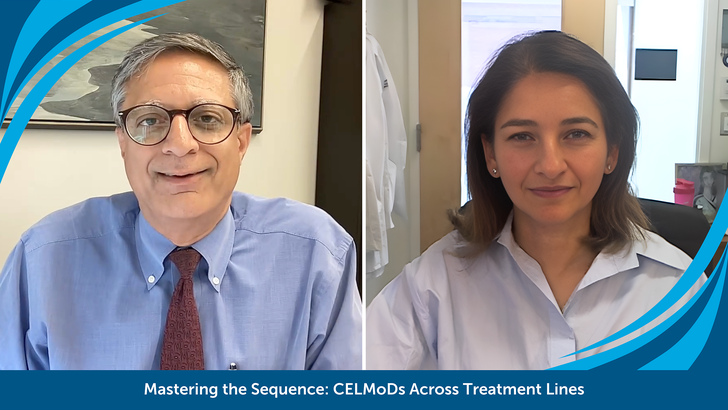
This is CME on ReachMD, and I'm Dr. Sagar Lonial. And today, here with me is Dr. Noopur Raje. Our topic today is sequencing CELMoDs across treatment lines in myeloma.
Noopur, can you briefly describe the CELMoD category of agents and what role they may play in the treatment and sequencing in myeloma?
Dr. Raje:
Yeah. Thank you so much for having me, Sagar. The way I think about CELMoDs is they're really the souped-up form of the new immunomodulatory drugs. So we know about lenalidomide, we are all very familiar with pomalidomide, and now we have these CELMoDs, which, in essence, are novel immunomodulatory drugs and they target a protein called cereblon, which is an E3 ligase modulator. It belongs to a complex. It's really important in myeloma cell proliferation, and targeting it with these new CELMoDs – we have 2 of them. We have one called iberdomide and the other one called mezigdomide, and they are even more potent than what we are so used to using, which is lenalidomide and pomalidomide. And their potency is several thousand-fold more than what you see with len and pom.
So they target this protein called cereblon, and by targeting it, they have downstream effects on certain transcription factors like Ikaros and Aiolos. And by doing so, they cause killing of your myeloma cells and reduction in the proliferation of the myeloma cells. What's really important, though, is I mentioned the word immunomodulatory in the beginning. And what we see here is – we've always known about the immunomodulatory effects of lenalidomide and pomalidomide, but what we see with both iber and mezi is that they're even more potent immunomodulators by acting on Ikaros and Aiolos. And what they do is can reverse an exhausted phenotype of T cells. They can increase NK cell activity that shows natural killer activity. And to me, this is incredibly important, especially now when all of us are so excited about CAR-T cells, about T cell-redirected treatments. So having this oral bioavailable option, which is orally bioavailable, is critical.
The other thing we've seen is we've done studies with both of these agents. We've studied iber in the maintenance setting. We've studied mezigdomide in combination with daratumumab. We've studied in combination with carfilzomib. We're trying to move this earlier and earlier in lines of treatment so that we're using these drugs in the up-front setting.
And what we are seeing here is, with the combinations of carfilzomib/daratumumab, we're seeing incredibly high response rates, to the extent of seeing minimal residual disease negative state, as well, and prolonged durations of remissions with these drugs. So I find that these novel immunomodulatory drugs are something which we all are going to incorporate in everything we do in myeloma, right from newly diagnosed myeloma all the way through relapsed refractory. And the beauty of them is they’re easy to combine even with the novel T cell-redirected treatments such as CAR-T cells and bispecifics.
Dr. Lonial:
Yeah. Thank you. I think that was a great discussion. And from my perspective, everybody is moving to the bright and shiny object of new immune therapy right now, but our backbone agents clearly have an important role to play. And getting newer versions of these backbone agents that are able to overcome drug resistance, perhaps even have activity in extramedullary disease, which we know mezi seems to penetrate into extramedullary plasmacytomas, those are really unique aspects of these 2 drugs in a brand-new class that I think are particularly well suited for much of what we're trying to do in the next wave of novel myeloma therapeutics.
So certainly, very excited about these opportunities. And again, the ability to partner them with many of our existing immune and nonimmune targets in general.
I think this has been a great discussion. Thank you so much, but our time is up. And thank you for joining us today.
Announcer:
You have been listening to CE on ReachMD. This activity is provided by Prova Education and is part of our MinuteCE curriculum.
To receive your free CE credit, or to download this activity, go to ReachMD.com/CME. Thank you for listening.

